The IPO SpaceX investors had been waiting on for over a decade finally happened, and it broke records on the way out the door. On June 12, 2026, Elon Musk’s rocket and satellite company began trading on the Nasdaq under the ticker SPCX, closing its first session up nearly 20% and instantly becoming one of the most valuable companies on the planet.
For a generation of retail investors who grew up watching Falcon 9 landings and dreaming of owning a piece of the company behind them, it felt like a moment they’d been promised was coming for years.
But the headline numbers only tell part of the story. Behind the record-breaking raise and the frenzied first-day demand sits a deal structured almost entirely on Musk’s terms — a sliver of the company sold to the public, a control structure that leaves outside shareholders with essentially no say, and a roadshow that skipped the usual rules of price discovery altogether.
None of that stopped the stock from popping.
This article walks through exactly how the SpaceX IPO (Initial Public Offering) came together: the date, the price, the valuation, why demand was so extreme, and what new shareholders are — and very much aren’t — actually buying into. If you’re considering buying shares of SpaceX or just trying to understand what happened, this is the full picture.
IPO SpaceX Date and the Basics
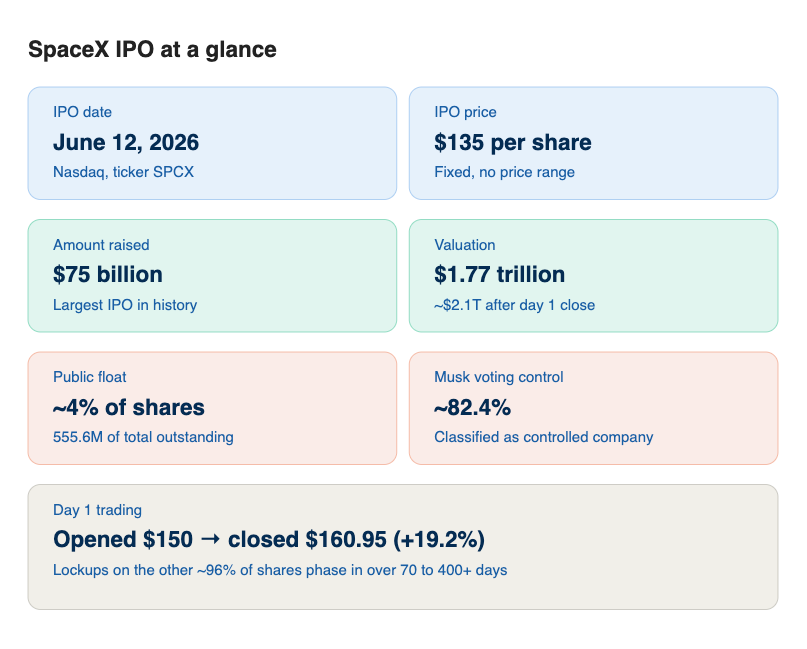
The IPO Spacex date was June 12, 2026, after the company priced shares the evening before at a fixed $135 each.
That pricing approach was itself unusual — instead of offering a range and letting institutional demand set the final number through a traditional roadshow, SpaceX simply named its price and let the market decide whether to show up. It showed up.
The order book reportedly ran more than double the available shares, with roughly $150 billion in orders chasing a $75 billion raise.
SpaceX sold 555.6 million shares, raising approximately $75 billion in the process — the largest IPO in history by a wide margin, surpassing Saudi Aramco’s 2019 listing. At $135 per share, the deal valued the company at roughly $1.77 trillion, a number that depends partly on the EchoStar spectrum deal and the Cursor acquisition closing as planned.
Stock Quote SpaceX: How Day One Actually Went
Trading opened around midday on June 12 at $150 per share, an 11% jump from the IPO price before a single public investor had even had a full session to react. From there, the stock climbed steadily and closed its first day at $160.95 — a 19.2% gain that pushed SpaceX’s market capitalization to roughly $2.1 trillion.
More than 500 million shares changed hands that day, the second-largest single-day volume for a new listing in Nasdaq history, trailing only Facebook’s 2012 debut.
Anyone checking a stock quote SpaceX a few days later was looking at a price still running well above the offer — reports put it 19% to 33% above the $135 IPO price in the days following the debut, even as the initial euphoria cooled slightly.
SpaceX Company Stock: What Pushed the Valuation So High
Part of what makes SpaceX company stock different from a typical IPO is that investors weren’t just buying a rocket company. In February 2026, Musk merged SpaceX with xAI in an all-stock deal that valued the combined entity at $1.25 trillion, folding his AI venture directly into the business going public.
That merger turned a company known for orbital launches and Starlink connectivity into something closer to a sprawling Musk conglomerate spanning aerospace, satellite internet, and artificial intelligence compute. Revenue tells a more complicated story than the valuation headline suggests.
SpaceX generated about $18.7 billion in revenue over the past year while recording an operating loss of roughly $4.2 billion — figures that put the company’s price-to-revenue multiple well outside what most public trillion-dollar companies command.
Among existing trillion-dollar public companies, the smallest by revenue still dwarfs SpaceX’s top line, and none of the others are currently posting an operating loss of that size.
The bet investors are making isn’t on current profitability; it’s on Starlink’s growth trajectory, Starship’s flight cadence, and the AI compute ambitions layered on through xAI.
IPO SpaceX: The Elon Musk Effect on Demand
It’s hard to separate the SpaceX IPO from sheer fan enthusiasm for Musk himself, fueled by years of Falcon 9 landings broadcast live and Starship test flights watched by millions.
That famously vocal online following created a built-in retail audience primed to buy in the moment shares became available, regardless of what the balance sheet said.
SpaceX leaned into that dynamic deliberately, reserving roughly 30% of the offering for retail investors — three times the typical 5% to 10% for a deal this size — through brokers including Robinhood, Fidelity, Charles Schwab, SoFi, and E*TRADE.
That retail-heavy allocation is also why the order book filled so fast and why the stock popped so hard on debut: a large, emotionally invested buyer base showed up on day one with cash ready, largely uninterested in haggling over price.
SpaceX Stock Prices: The Catch Few Headlines Mentioned
Here’s the detail that got buried under the celebratory coverage of record demand and a strong debut: those 555.6 million shares represent only about 4% of SpaceX’s total shares outstanding.
The other roughly 96% of the company remains in the hands of Musk, early investors, employees, and private backers — none of whom sold a single share as part of this offering.
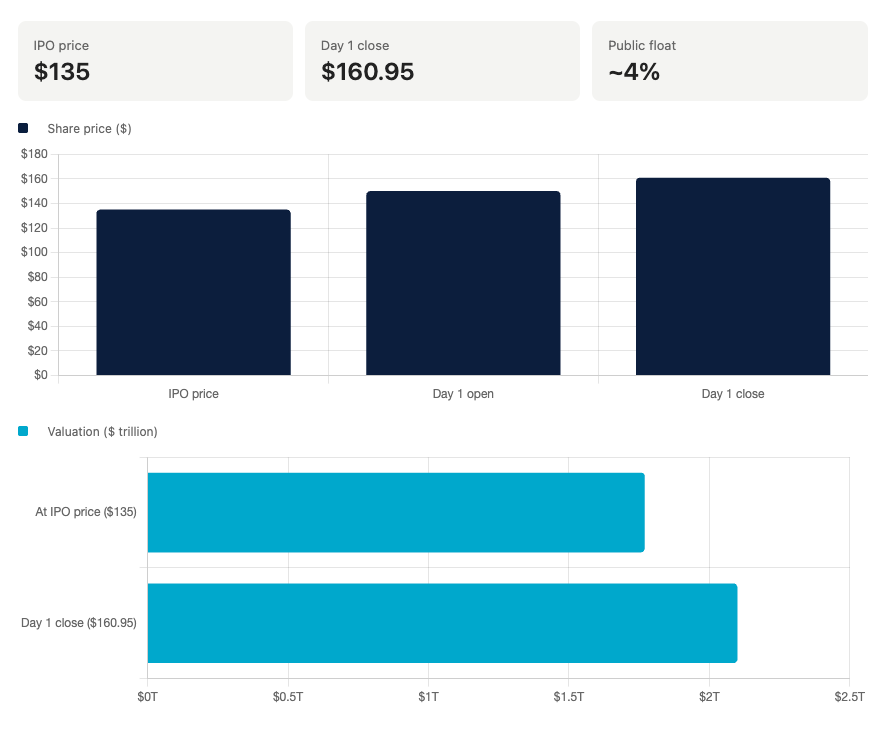
That tiny float matters enormously for anyone tracking spacex stock prices going forward. A market this thin means relatively small amounts of buying or selling pressure can move the price dramatically in either direction, which helps explain the size of the first-day pop.
It also means the headline $1.77 trillion valuation was set by trading activity on a sliver of the company, not the kind of broad price discovery that normally anchors a valuation that size.
Lockups Are Coming
Most of that locked-up 96% isn’t tradable yet. Depending on the specific agreement, insiders, employees, and early investors face lockup periods ranging from roughly 70 days to over 400 days before they can sell.
As those restrictions lift in stages over the company’s first year as a public business, more supply will gradually hit the market — and increased supply against the same demand typically puts downward pressure on price.
Anyone buying shares of SpaceX today is buying into a stock whose true trading dynamics won’t be fully visible for months.
Musk Retains Control — Minority Shareholders, Not So Much
This is the part that matters most for anyone thinking about what they’re actually purchasing. According to SpaceX’s SEC filing, Musk holds roughly 82.4% of voting power after the offering, a level of control that qualifies SpaceX as a “controlled company” under Nasdaq rules — a classification that exempts it from several standard governance requirements public companies normally have to follow.
In practical terms, that means new shareholders are buying economic exposure to SpaceX’s performance without any meaningful influence over how the company is run. Musk alone can elect or remove the board, approve or block major corporate decisions, and steer strategy without needing to build consensus among outside investors.
Public shareholders get a stock quote SpaceX they can watch move, but no real lever to pull if they disagree with how the company is being managed.
For a business this large and this unconventional in its growth bets — Starship’s flight rate, AI data centers in space, ambitions toward a lunar base — that’s a meaningful amount of trust being placed in one person’s judgment with no built-in check from the shareholder base.
It’s a structure increasingly common among founder-led tech companies, but rarely this extreme at this scale. Combined with the thin float, it leaves SpaceX’s public shareholders in an unusual position: fully exposed to the stock’s volatility, with almost none of the influence that equity ownership typically implies.
IPO SpaceX: Where This Leaves Investors
The IPO SpaceX pulled off was historic by every conventional measure — the largest raise ever, a valuation rivaling Apple and Nvidia, and a first-day pop that rewarded early buyers handsomely.
But the structure underneath those headlines tells a more cautious story: a tiny public float, a revenue picture that doesn’t yet justify the multiple on fundamentals alone, staggered lockups that will add supply over the coming year, and a voting structure that leaves Musk in near-total control regardless of what public shareholders think.
None of that makes SpaceX company stock uninvestable — plenty of founder-controlled companies have rewarded long-term shareholders handsomely. But it does mean buying in requires separating the excitement of owning a piece of SpaceX from a clear-eyed read on what that ownership actually gets you.
If you’re drawn to the infrastructure side of this story, it’s also worth understanding how Starlink’s internet business fits into the bigger picture, since satellite connectivity remains one of the more grounded, revenue-generating pieces of what Wall Street just priced at $1.77 trillion.