Oura Ring utilizes the Readiness Score as a daily metric that provides a holistic view of your body’s recovery status. It combines data from your sleep, heart rate variability (HRV), resting heart rate (RHR), body temperature, and previous activity to determine how prepared you are to take on the day.
The score ranges from 0 to 100, with higher numbers indicating better recovery and readiness. Unlike simple step counts, this score reflects your body’s readiness for physical or mental exertion, helping you decide whether to push hard or prioritize rest.
By analyzing multiple physiological signals from the Oura smart ring, the algorithm calculates a personalized baseline. For example, factors like sleep quality, nighttime HRV, and recent activity levels are weighted to produce a comprehensive readiness metric. The Oura app presents this score alongside actionable insights, such as suggestions for workout intensity or recovery activities.
This guide will help you decode what your daily readiness truly means. Enjoy the reading.
Key Factors That Influence Your Readiness Score
Sleep and Rest
Sleep is the foundation of the Readiness Score. The Oura Ring tracks sleep stages (deep, light, REM), sleep duration, sleep efficiency, and sleep latency. A full night of restorative sleep, especially with sufficient deep sleep, positively impacts your readiness.
Conversely, fragmented sleep or insufficient duration lowers the score. The device monitors your sleep quality by analyzing movements, heart rate patterns, and breathing disturbances.
Heart Rate Variability (HRV)
HRV is a key indicator of autonomic nervous system balance. The Oura Ring measures the time between heartbeats during sleep to compute your nightly HRV metric.
Higher HRV typically signals better recovery and a stronger parasympathetic response, leading to a higher Readiness Score. Chronic stress or overtraining can reduce HRV, reflecting lower readiness.
Resting Heart Rate (RHR)
Your resting heart rate, measured overnight, reflects cardiovascular recovery. A lower RHR compared to your baseline indicates good recovery, while an elevated RHR may suggest stress, illness, or poor sleep.
The Oura wearable tracks these trends to adjust the readiness score accordingly.
Body Temperature
The Oura Ring monitors skin temperature trends throughout the night. A deviation from your baseline temperature may indicate early signs of illness or hormonal changes, which can negatively affect readiness.
Temperature trends provide context for why your score might be lower than usual.
Activity and Movement
Your previous day’s physical activity influences recovery. High-intensity exercise depletes energy stores and increases physiological strain, requiring more time to recover.
The readiness metric accounts for your daily activity level, steps, and calories burned, adjusting the score based on how well you’ve bounced back.
Oura ring: How to Use Your Readiness Score for Better Daily Performance
The Readiness Score is a practical tool for optimizing your day. In the morning, check your Oura app to see the score and read the personalized recommendations.
If your score is high (above 85), consider engaging in challenging workouts or demanding cognitive tasks. A medium score (70–85) suggests moderate activity, while a low score (below 70) signals a need for recovery-focused activities like walking, stretching, or mindfulness.
Use the readiness metric to adjust your schedule: plan intense training on high-readiness days and prioritize sleep or low-impact movement on low-readiness days. Over time, you’ll notice patterns that help you align your performance with your body’s natural recovery cycles.
The Oura Ring also provides a daily trend line, allowing you to track how lifestyle factors affect readiness like:
- diet,
- stress, and
- bedtime.
Readiness Score vs. Sleep Score vs. Activity Score: What’s the Difference?
While the Readiness Score is a composite, the Oura Ring also provides separate scores for sleep and activity.
The Sleep Score focuses exclusively on sleep quality, duration, and timing, scored from 0–100. The Activity Score measures daily movement relative to your goals, including steps, calories, and active time.
In contrast, the readiness metric integrates these scores with physiological measurements like HRV and RHR to produce a complete readiness picture.
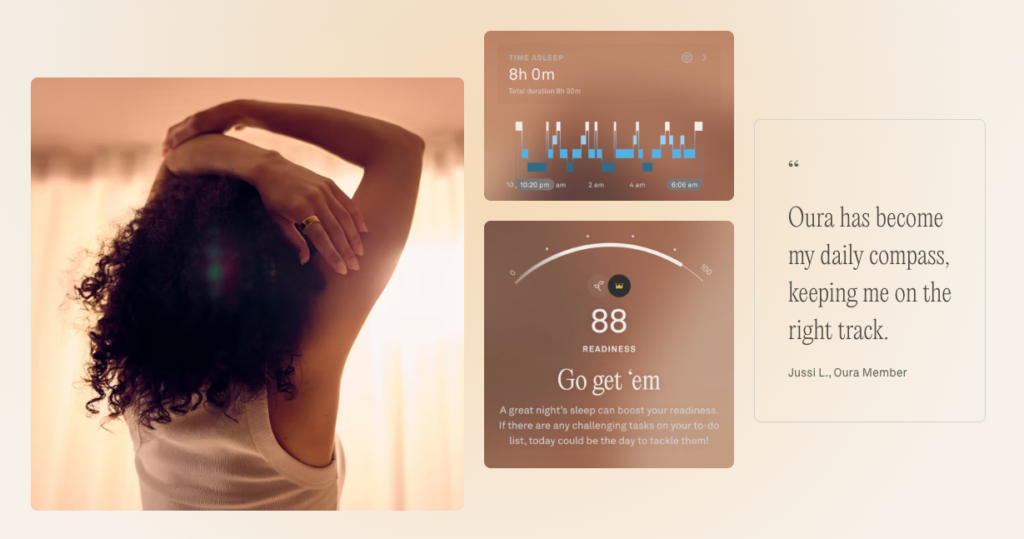
For example, you might have a high Sleep Score but a low Readiness Score if your HRV is poor or your body temperature is elevated. Similarly, a high Activity Score from a heavy training day may suppress readiness the next morning.
Understanding the differences helps you pinpoint which area needs improvement. The Oura app displays all three scores on the home screen, making it easy to compare.
Common Myths About the Oura Readiness Score
One myth is that a high Readiness Score always means you should push yourself. In reality, contextual factors like mental stress or upcoming events should also guide your decisions.
Another misconception is that the score is solely based on sleep; as shown, it incorporates multiple metrics. Some users believe they must achieve a perfect 100 daily, but the score is designed to fluctuate with natural recovery cycles and a range of 70–100 is normal.
Additionally, the readiness score is not equivalent to a medical diagnosis. While it provides useful insights, it should not replace professional health advice.
Lastly, some think that ignoring low readiness and training anyway will improve scores over time, but this can lead to overtraining and decreased performance. Instead, low scores should prompt rest or active recovery.
Tips to Improve Your Oura Readiness Score
To raise your daily readiness, focus on consistent sleep hygiene:
- maintain a regular bedtime,
- limit caffeine after noon, and
- create a cool, dark sleep environment.
Also, boost HRV by incorporating stress reduction practices like deep breathing, meditation, or light yoga. Monitor your body temperature trends and stay hydrated.
Balance your activity levels, avoid sudden spikes in exercise intensity and allow for recovery days. Use the Oura app’s “Explore” feature to follow guided sleep and readiness programs.
Additionally, avoid alcohol and heavy meals close to bedtime, as they disrupt sleep quality and HRV. Over time, these habits will stabilize and improve your readiness metric.
Science and Research Behind the Readiness Score
The Oura Ring’s algorithms are grounded in peer-reviewed sleep medicine and physiological research, making it one of the most scientifically validated consumer wearable technology devices on the market, especially compared to emerging gadgets like smart glasses.
A study published in Nature Scientific Reports (2020) found that the Oura Ring demonstrated over 96% accuracy in detecting sleep versus wakefulness compared to clinical polysomnography, the gold standard for sleep analysis.
Additionally, research from the Journal of Clinical Sleep Medicine validated the ring’s ability to identify sleep stages with sensitivity rates exceeding 80% for REM and deep sleep detection.
HRV measurement, a cornerstone of the Readiness Score, has been extensively studied in sports science and cardiology. According to a 2019 study in Frontiers in Physiology, HRV-based recovery monitoring accurately predicted athletic performance readiness in over 75% of cases among endurance athletes.
The Oura Ring’s nightly HRV readings align closely with ECG-derived measurements, with a mean absolute error of less than 3ms reported in independent validation studies.
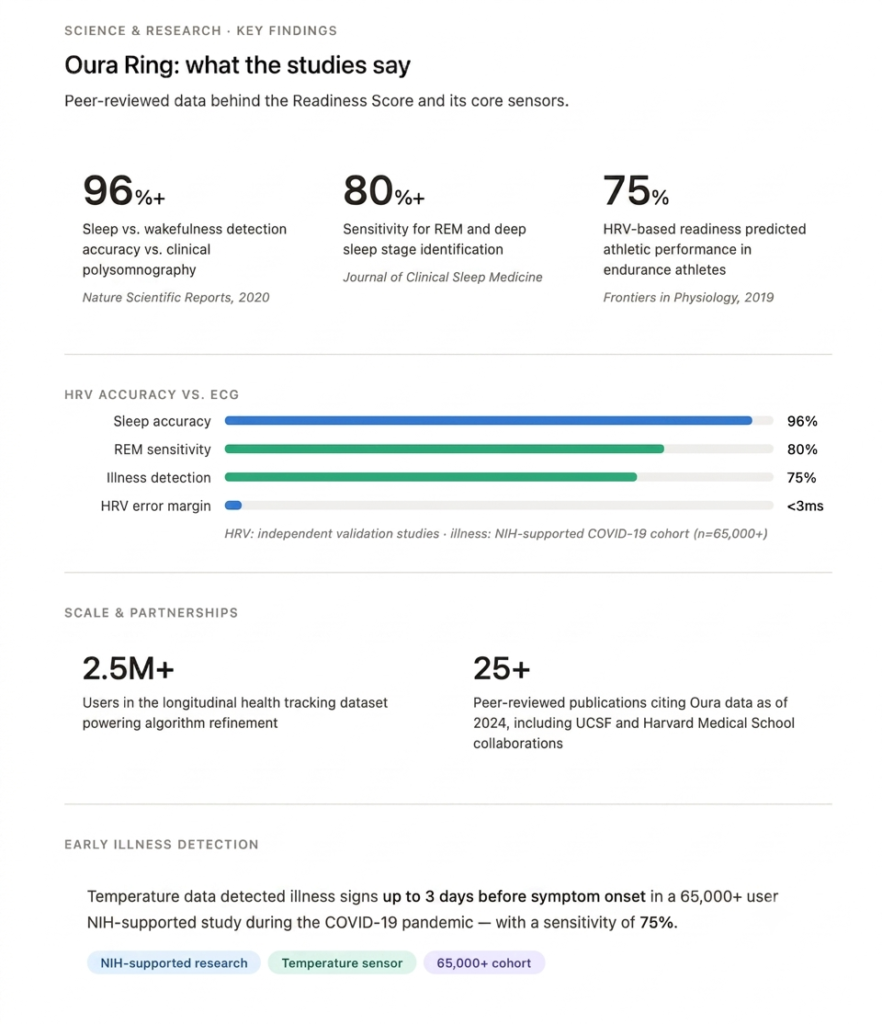
The ring’s temperature sensor has also demonstrated clinical relevance. Research supported by the National Institutes of Health (NIH) and conducted during the COVID-19 pandemic showed that Oura Ring temperature data could detect early illness signs up to three days before symptom onset, with a sensitivity of 75% in a cohort of over 65,000 users.
The Oura team continuously refines its scoring model through one of the largest longitudinal wearable health tracking datasets available, comprising data from over 2.5 million users worldwide. This scale allows the algorithm to improve personalization and accuracy over time.
For users seeking deeper scientific context, Oura publishes research summaries and collaborates with institutions such as the University of California San Francisco (UCSF) and Harvard Medical School, with over 25 peer-reviewed publications citing Oura data as of 2024.
This robust scientific foundation makes the Readiness Score far more than a wellness estimate, it is a credible, research-backed metric for everyday performance and recovery optimization.
Oura Ring: Heart Health Insights
It provides heart health metrics like resting heart rate and HRV, which are vital for cardiovascular wellness. Nightly RHR trends can indicate changes in fitness levels: a decreasing RHR over weeks suggests improved cardiovascular efficiency. HRV, often linked to resilience, helps maintain a healthy autonomic nervous system.
Abnormal readings, such as a sustained increase in RHR or drop in HRV, may prompt earlier recognition of overtraining or potential health issues.
While not a medical device, the Oura wearable offers insights that can encourage proactive discussions with healthcare providers. The readiness score, in particular, can reflect overall cardiovascular recovery.
Activity and Movement: The Dynamic Duo with Readiness
Your daily activity level directly influences the readiness score. The Oura Ring tracks steps, calories burned, and active time, and classifies activities into low, moderate, and high intensity. The readiness metric leverages this to optimize performance: a high activity day triggers a recovery need, lowering readiness temporarily.
Using the readiness score, you can periodize your training: schedule high-intensity workouts on high-readiness days and recovery activities like walking or stretching on low-readiness days.
This approach aligns with principles of performance optimization, helping you avoid plateaus and reduce injury risk. The Oura app also sends activity prompts based on your readiness, encouraging consistent movement.
Your Readiness Score Is a Conversation, Not a Command
The Oura Ring’s Readiness Score is one of the most powerful applications of wearable technology available today, but its real value lies in how you respond to it over time. No single number tells the whole story. A 72 on a stressful workweek looks different from a 72 after a relaxed weekend. Context always matters.
What makes health tracking through the Oura Ring exceptional is the feedback loop it creates between your daily habits and your physiology. The more consistently you monitor your score, the more clearly you’ll see how late nights, intense training sessions, alcohol, or even a high-stress meeting ripple through your recovery. That awareness, built gradually, is what transforms the Oura Ring from a gadget into a genuine wellness tool.
As wearable technology continues to evolve, devices like the Oura Ring are redefining what personal health tracking can look like, moving beyond step counts and calories toward a deeper, more nuanced picture of how your body truly recovers. Use your Readiness Score as a starting point each morning, not a verdict. Pair it with how you actually feel, what the day demands, and what your long-term goals require.
Over weeks and months, the patterns that emerge will help you train smarter, sleep better, and build a lifestyle that works with your biology instead of against it.
That’s the real promise of personalized health data: not perfection, but progress you can actually measure.